
We’ve all been there: staring at a blank VS Code window, paralyzed by the thought of writing the same boilerplate authentication, database schemas, and Nginx configurations for the hundredth time.
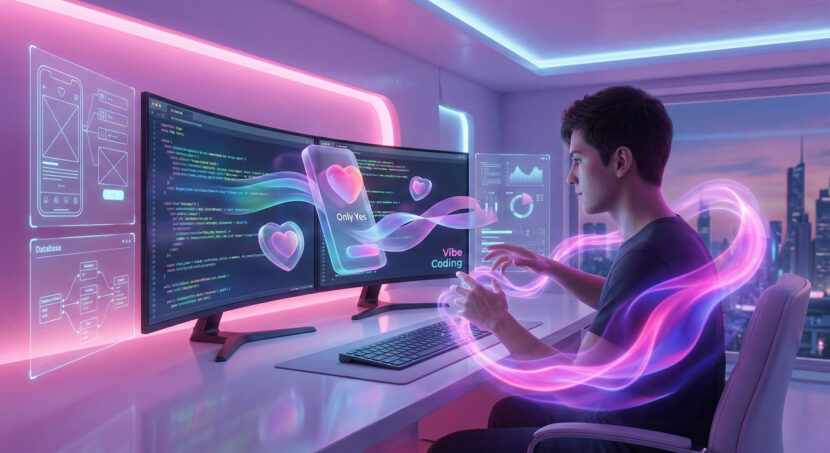
But recently, something shifted. I stopped “coding” in the traditional, line-by-line sense, and I started Vibe Coding.
The Paradigm Shift: From Syntax to Intent
Software development is undergoing a massive transformation. For my latest project, Only Yes (a Valentine’s experience builder), I didn’t spend weeks grinding through syntax errors. Instead, I used AI as a force multiplier to translate my high-level intent into production-ready code.
Vibe coding isn’t about being lazy. It’s about efficiency. As an experienced developer, I already knew the “vibes” I wanted for this project:
- A sleek, romantic aesthetic that felt premium.
- An infuriatingly funny “No” button logic.
- A rock-solid payment flow for users who wanted to upgrade.
By focusing on the Architecture (Next.js + Supabase) rather than the semicolon, I was able to build a full-stack application at the speed of thought.
Where the “Vibe” Met the “Metal”
1. The Interaction: The Infinite “No”
One of the most satisfying parts of the app is the “No” button that dodges the user’s cursor. I didn’t sit down and calculate coordinate offsets manually. Instead, I described the feeling of the interaction to my AI pairing partner.
Through iterative “vibe” checks, we refined the logic: “Make it move faster as the mouse gets closer, but keep it within the container bounds.” The result? A perfectly cheeky user experience that felt exactly right.
2. Solving the Hard Parts
Vibe coding really shines when things get messy. I hit two major roadblocks:
- The Post-Upgrade Logic: Handling the state change once a user pays to unlock premium features.
- Nginx Caching Issues: A classic “metal” problem that usually eats up hours of debugging.
Instead of hunting through StackOverflow for hours, I described the specific caching behavior I was seeing. We refined the Nginx configuration and the React state logic in real-time. What used to be a “day-ruiner” of a bug became a 15-minute conversation.
The Takeaway: Human Experience > Boilerplate
At the end of the day, Vibe coding is about the human at the other end of the screen. When we spend less time fighting with tools and more time architecting the experience, the final product is better. It allows us, as builders, to focus on what actually matters: the UX, the humor, and the value we provide to the user.
“Only Yes” is a testament to what happens when you combine years of dev experience with the raw power of AI-assisted creation. It’s not just code; it’s a vibe.
See it in action:
Curious about how a “vibe coded” app actually feels? Head over to valentine.matin.in and try to click “No.” (Spoiler: You can’t.)